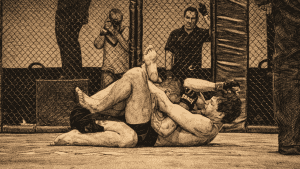
I am still the only person in Australia to win an MMA fight and a championship title via a gogoplata submission set up from rubber guard. Eddie Bravo gave me a shoutout, the sequence was featured on his “Mastering the System” series, and for a while, it felt like rubber guard was going to be a significant part of my identity in this sport. I tell you that not to brag, but to make clear that when I say I no longer teach rubber guard, it is not because I never understood it or never made it work. I did. The reasons I walked away from teaching it are more interesting than that.
Coming from a Machado lineage, I never found rubber guard controversial the way others did. While I heard about people at some Gracie schools who were reportedly getting scolded by their coaches for playing rubber guard, lockdown or twister in class, we had the freedom to explore. My coach had trained with Eddie Bravo in LA, and those exact positions were in our purple belt syllabus. I took full advantage of that freedom.
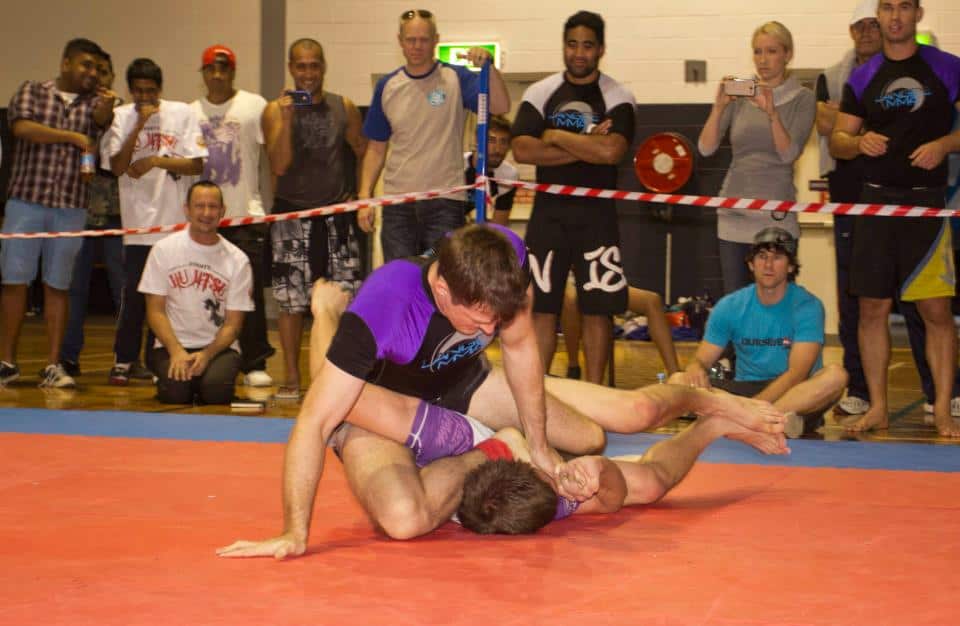
The system was developed by Eddie Bravo, as a strip club DJ who was afraid of brain damage and wanted a way to minimise head trauma from bottom guard if he ever had to fight in MMA for money. But he never had to rely on it in the cage for cash, as he used it in a match and eventually set up a triangle choke to submit Royler Gracie at ADCC 2003, which was enough to build an empire.
Since then, the expectation that every 10th Planet member would become a rubber guard master has since quietly faded. The system is still taught, but 10th Planet as a whole seems to align with the current no-gi meta, and that meta has largely left rubber guard behind. Any rubber guard master you find today is almost certainly a 10th Planet black belt, but not every 10th Planet black belt is a rubber guard master.
The Rise and FALL of Rubber Guard
The decline of rubber guard hype generally mirrors the decline of closed guard in high-level competition. The overall standard of grappling has risen so dramatically that the wide skill gaps which once made submissions from bottom a frequent occurrence in early MMA have largely closed. Threats of armbars and triangles remain valuable tools to force movement and reaction, but finishing from bottom guard is far less common than it once was.
In professional no-gi jiu-jitsu, closed guard has also lost ground. Players would rather open their guard and look for leg entries, like K-guard, over sitting in a position that pins your hips and can be neutralised by good posture or a simple stack. While it naturally retains a decent self-defence application, Ben Saunders also managed to secure the first omoplata submission finish in UFC history from rubber guard, which deserves an honourable mention.
CHANGING FROM Competitor to Coach
I played rubber guard extensively during my blue- and purple-belt years, and it genuinely worked for me at a competitive level.
When I started coaching, rubber guard was naturally one of the things I was eager to pass on. I had deep technical knowledge of the system, a competitive record to back it up, and, admittedly, a ready-made story about winning an Australian title that I was happy to wheel out. I went into those early lessons genuinely excited.
What I was met with was a room full of people who could not comfortably get into the position at all.
Attribute-Based Jiu-Jitsu
What I had stumbled onto is something I now call “attribute-based jiu-jitsu”: techniques that depend on specific physical attributes to function, where the attribute is doing as much work as the technique itself.
Rubber guard is an obvious example, but it is far from the only one. You can think of multiple positions where a tall, long-limbed player it is a natural, almost effortless position to establish and work from. Where for someone shorter with a stockier frame, achieving the same mechanical advantage is a completely different proposition. None of these techniques are invalid, but if you are coaching them without acknowledging the attribute that makes them work, you are setting most of your class up to bang their head against a wall.
Specifically for the rubber guard, the attribute is hip flexor flexibility. The standard response from the 10th Planet camp has always been either to stretch and develop that flexibility or to use enough hip angle that the flexibility requirement drops. Both are fair points. But most people who train jiu-jitsu are not looking to do additional mobility work outside of class to unlock a single guard system. They want to train, roll, have fun and get better. And there is a deeper problem: if someone already has the hip mobility to create the angle needed for rubber guard, their traditional closed-guard attacks are already going to work better anyway.
The attribute that makes rubber guard accessible is the same attribute that makes it unnecessary.
I suspect attribute-based concerns were part of the reason the Gracie side pushed back on rubber guard from the beginning, even if that was never quite how it was framed.
Making the Switch to Williams Guard
After seeing how little rubber guard transferred to most of my students and needing meniscus surgery on my preferred rubber-guard leg (Which I can’t blame entirely on rubber guard), I switched to playing and teaching Williams Guard.
For those unfamiliar, Williams Guard is a closed guard variation in which you control your opponent’s posture by securing it to your own leg with your grips. The defensive benefits are similar to rubber guard in that it disrupts your opponent’s structure from bottom position, but the flexibility requirement is dramatically lower. If you can bring your knee to your chest, you can get into Williams Guard. That covers the vast majority of people walking into any jiu-jitsu gym.
It actually existed within the 10th Planet system under the name “London,” though it was removed after a counter was identified. My view is that even when that counter lands, you still end up in a better position than standard bottom closed guard, and in MMA, that distinction matters. Far too often, we see fighters abandon closed guard entirely, opening up and surrendering back exposure as they scramble toward the cage. Williams Guard offers a way to stay composed, disrupt the top player’s posture, and look for submissions or sweeps without requiring attributes most people simply do not have.
The shift worked immediately. Students could actually get into the position. I had people successfully use it in competition within months of learning it, and the buy-in across different body types, ages and experience levels was far higher than anything I had seen with rubber guard.
At the minimum, I teach it as a way to set up an omoplata, which you can use to sweep or stand back up. I even made a breakdown video of it, which surprisingly I could not find any footage of Shawn Williams, who it is named after, using it in competition.
What It Taught Me About Coaching
There is a stage many coaches go through where you believe the job is to impress people with how much you know. You have drilled a niche system for years, you have the competition results to prove it works, and you cannot wait to pass it all on. What nobody tells you is that demonstrating the full depth of your knowledge about a position is often the least useful thing you can do for a room full of people at different stages, with different bodies, and different goals.
I had to learn that the hard way with rubber guard.
The urge to teach everything I knew about the system was, if I am honest, more about my ego than my students’ development. The Gogoplata win was a great story. The Eddie Bravo shoutout was a nice credential. And I wanted people to know about it. But wanting people to know about your credentials and actually improving their jiu-jitsu are not the same thing, and confusing the two is one of the easiest traps in coaching.
The better measure was never how impressed the room looked. It was how many people could actually use, implement and remember what I showed them the next time they rolled.
Rubber guard failed that test badly. And once I accepted that, a more honest question followed: how much of what I teach is actually attribute-based jiu-jitsu wearing the costume of technique? It is very easy to say “I like this” or “this works for me” without acknowledging that the reason it works is that you happen to have the right build, length or mobility for it. That can make for a great demonstration, but it isn’t coaching. The distinction matters, especially when you do not know who will walk through the gym door on any given day.
The job is to find what works for the widest range of people in the room, and to filter out the specialist material that will only ever apply to a select few in a handful of scenarios. That filtering process is uncomfortable when it means shelving knowledge you spent years building. But it is one of the most important things a coach can learn to do. The modern-day eco crowd may call these “Invariants”, but I am sure a few old-school coaches would simply know this as “good jiu-jitsu”.
I never did get my 10th Planet black belt as I had once dreamed. But what the rubber guard years taught me about ego, about attributes, and about the difference between teaching and performing turned out to be worth more than anything else.