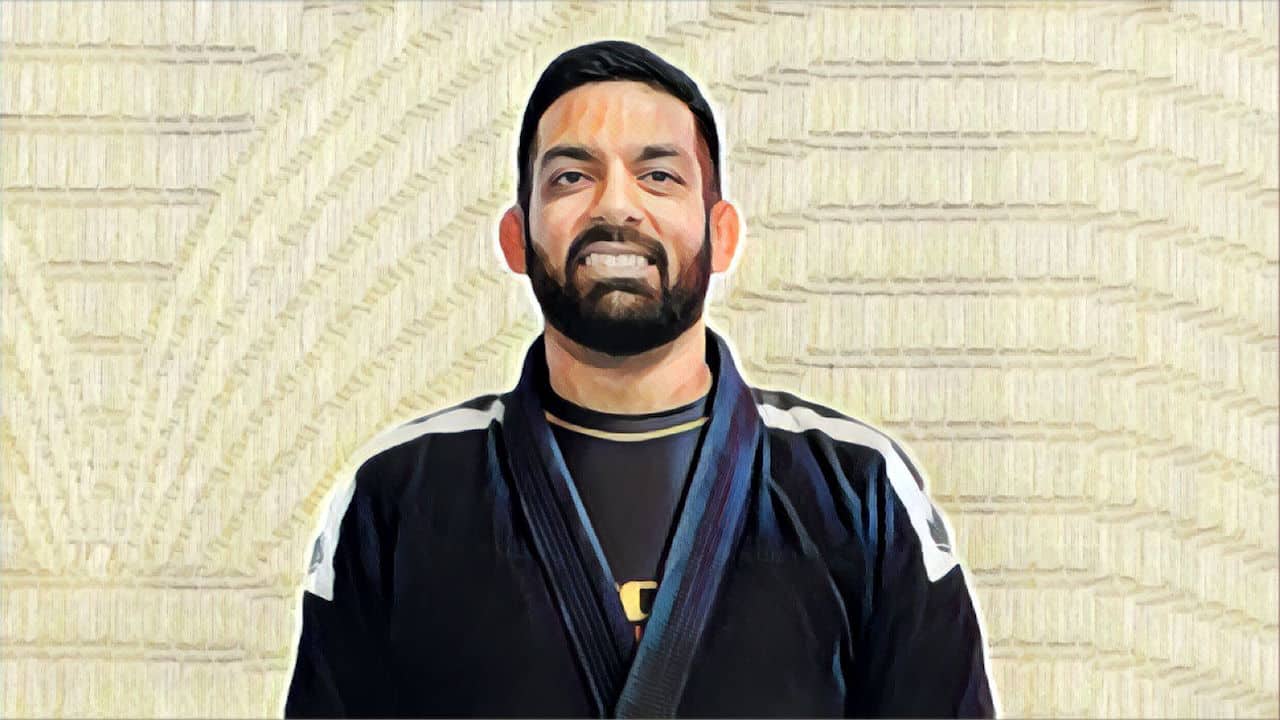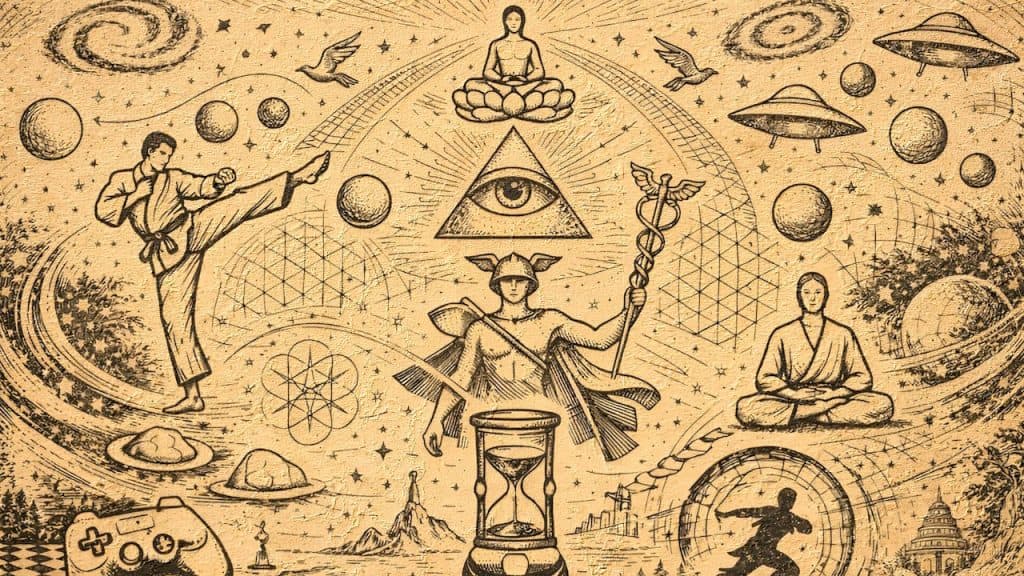
I talk to Michael Phillip, host of the long-running philosophy and esoterica podcast Third Eye Drops, where he conducts what he calls “mind melds” with authors, musicians, thinkers, and mystics on topics ranging from Jungian psychology and mythology to consciousness, technology, and the nature of reality. Michael also brings a personal martial arts background, which makes him an unusually thoughtful conversation partner on the deeper dimensions of combat sports. In this episode, we explore the ancient and mythological roots of grappling and play, the Hermetic trickster archetype as a lens for understanding martial arts, how motor learning and games-based coaching connect to ideas of structure and freedom, and what it really means to face loss in competition and in life.
Listen to Michael Phillip
TOPICS COVERED
The Nature of Play and Skill Acquisition
There is a version of play available to everyone from the very beginning: the casual, exploratory fumbling of someone who has no idea what they are doing. But there is a deeper form of play that is unlocked only through serious investment in a skill, and that distinction matters enormously for how we think about learning and mastery.
Neuroscience offers a useful frame here. In a genuine flow state, the brain enters a condition called transient hypofrontality, where the self-monitoring, self-conscious prefrontal regions temporarily quiet down. What remains is something egoless, fully present, and genuinely spontaneous. The paradox is that this state cannot be willed into existence. It only becomes accessible once enough structure and repetition have been absorbed into the body that conscious thinking is no longer required. You have to earn your way into freedom.
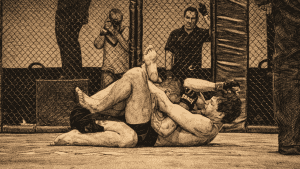
Grappling seems particularly well-suited to producing this experience. The push and pull of two bodies against one another is one of the oldest physical languages in existence, older than culture and probably older than the human species itself. Animals play-wrestle. Children play-wrestle. The instinct is so deeply embedded that it requires almost no introduction. That evolutionary depth may be exactly why jiu-jitsu, in particular, carries a quality that practitioners often struggle to articulate but immediately recognise: it feels like something more than sport. It feels like play in the truest, most ancient sense of the word.
The Hermetic Trickster and the Rhythm of Structure vs. Play
Michael introduces one of his favourite myths, the story of baby Hermes stealing Apollo’s sacred cattle, as a perfect allegory for how innovation actually happens: not through polite incremental improvement, but through transgression.
“It’s a story about how play and completely challenging and actually insulting the status quo actually leads to innovation. Eventually, the thing that challenged it and came from the outside becomes a part of the new establishment.”
We map this directly onto the history of martial arts. MMA stripped away the cultural baggage that wasn’t doing anything useful in traditional styles, keeping what worked. Within jiu-jitsu itself, leg locks were once considered taboo, practically a gentleman’s agreement not to rip someone’s ACL, yet they became undeniable once practitioners committed to developing them seriously. I share a compelling origin story here: an early rivalry between the Gracie school and the Fadda school, in which the Gracies reportedly suffered significant losses via foot locks, may have seeded the cultural disdain that lasted for decades. The Hermetic trickster energy came in, overturned the structure, and then became the new structure. And then, inevitably, the cycle begins again.
Michael and I both note this rhythm of transgression, absorption, new orthodoxy, and fresh transgression seems to be a permanent feature of any living martial art. The people who were revolutionary ten or fifteen years ago are now the old guard, their once-radical games considered passé by the next generation.
Hermes Trismegistus, Thoth, and the Archetype of Information
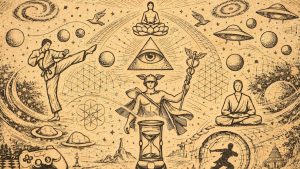
Michael takes us deep down a rabbit hole: the figure of Hermes Trismegistus, the legendary sage of ancient Egypt associated with the Hermetic texts, the Emerald Tablet, and the phrase “as above, so below.” He traces the threads of syncretism that link the Greek trickster Hermes to the Egyptian god Thoth, patron of scribes, language, and writing, and then to this third, even more mysterious composite figure.
What Michael finds remarkable is how durable the archetype is. Thoth invents language. Hermes is the god of communication, speed, boundaries, and novelty. Hermes Trismegistus downloads the architecture of the cosmos. The Jungian psychologist James Hillman argued we are living in an age of Hermes, defined by our obsession with information, connectivity, and the rapid exchange of ideas.
“Even you could say grappling is an exchange of information. It’s a competition of information.”
I point out that hieroglyphic depictions of wrestling have been found in Egyptian tombs, complete with holds we still recognise today, drawing a direct line between this ancient information-obsessed culture and the grappling arts. Michael and I both find it striking that the internet-driven explosion in jiu-jitsu technique over the last five to ten years, through instructionals, YouTube, and global sharing of knowledge, is, in this light, a perfectly Hermetic phenomenon. The art accelerates precisely because information flows faster.
Games-Based Learning and Constraint-Led Coaching
We dig into what modern motor learning research suggests about how skills are actually acquired. The traditional model of instruction, drilling, and free rolling works, but I explain that there is a growing body of evidence and coaching philosophy suggesting that play within constraints can produce faster, deeper, and more intuitive learning outcomes.
Rather than simply telling a student what to do, the coach designs a game with sufficiently tight parameters so the student discovers the intended technique on their own. I describe it as similar to the haiku form: the restriction does not prevent creativity, it provokes it.
“You give them such guidelines to the game that you’re confident they will discover the intended outcome on their own. So it’s that interplay between structure and play that’s really what they’re trying to develop.”
Michael draws an apt analogy from video games: a completely open-world game with no narrative direction becomes aimless. The best games, like the best lessons, find the right amount of open-endedness. Too much freedom produces chaos; too much structure produces rote imitation. The coach’s art is finding the constraint that opens the door.
Resources
Quotes
“Play proceeds everything, but you don’t really fully play until you’ve mastered to an extent. And then that’s where it gets really interesting.” – Michael Phillip
“Grappling is an exchange of information. It’s a competition of information.” – Michael Phillip
“The Hermetic trickster energy defies the establishment, then becomes a part of the establishment, and then it happens all over again, over and over, in so many different ways.” – Michael Phillip
“To get the thing you want, you have to eat the shit you don’t want over and over and over again until you kind of get there.” – Michael Phillip
“Part of play is losing, and understanding how to cope with loss projects itself forward into every other part of your life.” – Michael Phillip
Links
If you enjoyed this episode of The Sonny Brown Breakdown Podcast, then make sure to rate, subscribe and share the podcast.